

Knee Soft Tissue Ultrasound Sandwell
Private Knee Ultrasound Scans in our Ultrasound Clinic near Sandwell.
Knee Soft Tissue Ultrasound Near Sandwell
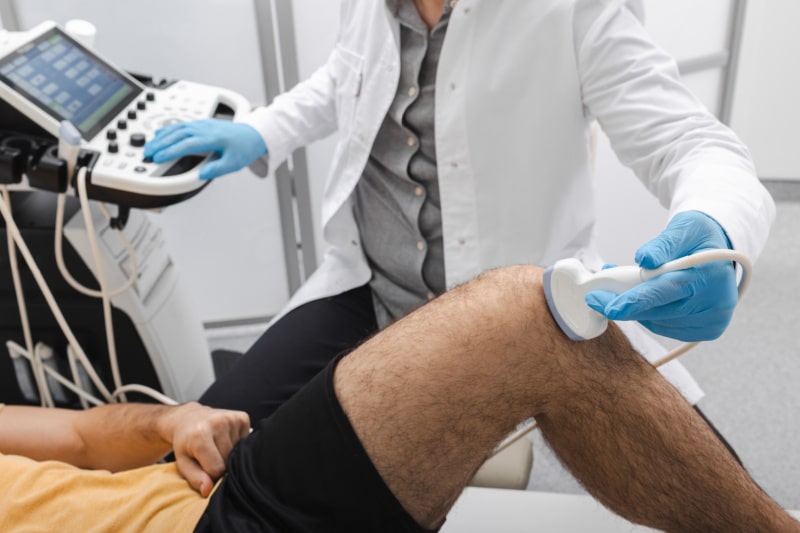
A knee soft tissue ultrasound scan is a procedure that uses high-frequency sound waves to produce diagnostic images. It is a safe, non-invasive, and ionising radiation-free examination. Knee ultrasound is a valuable diagnostic tool for detailed imaging of the knee joint and surrounding soft tissues. It provides real-time visualisation, making it particularly useful for assessing various structures. You do not need a GP referral.
Here are the key Reasons to have a knee soft tissue ultrasound:
- Assessment of Structures: Knee ultrasound evaluates cartilage, synovium, joint effusion, tendons, ligaments, and peripheral menisci.
- Pathology Detection: It helps identify abnormalities and associated conditions.
- Knee Pain: Ultrasound aids in diagnosing the cause of knee pain.
- Trauma Assessment: Detect lesions after muscle trauma or joint injury.
- Bulging Fluid: Detect fluid bulging from a swollen or inflamed knee joint.
- Popliteal Cyst (Baker's Cyst): Assess the cyst arising between tendons.
- Dynamic Imaging: Observe joint surfaces in motion.
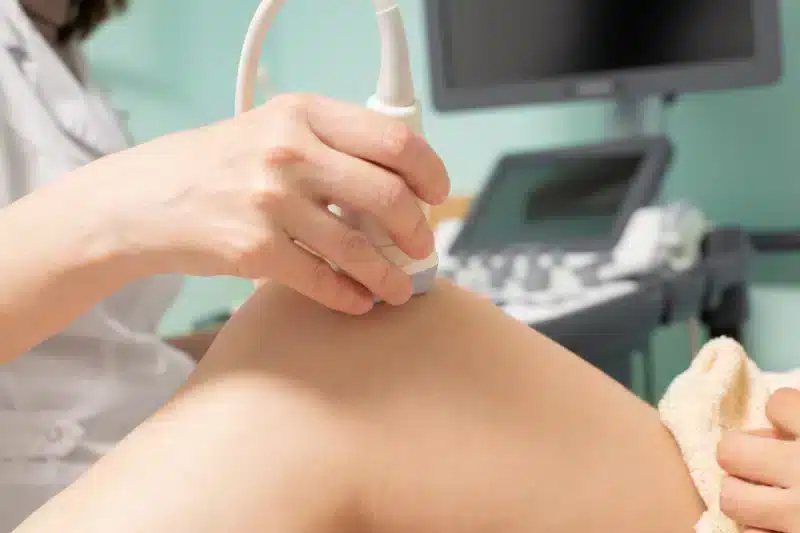
Remember, early detection and accurate evaluation play a crucial role in managing knee conditions. If you experience knee pain or have concerns, consult your healthcare provider for further evaluation and consider a knee ultrasound.
Knee Soft Tissue Ultrasound Scan
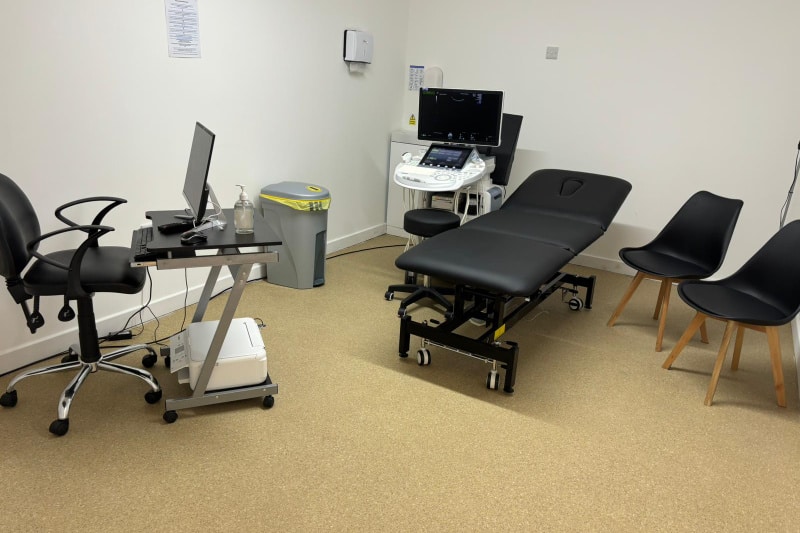
At Universal Ultrasound Diagnostics, we are dedicated to providing exceptional private knee soft tissue ultrasound scans at our knee soft tissue ultrasound clinic in Birmingham, UK. We offer flexible and convenient dates and times that suit your needs and preferences. With our cutting-edge Ultrasound systems and highly skilled, qualified and experienced staff, we deliver precise and reliable imaging for our private clients and referring practitioners in a comfortable and discreet setting. Our commitment to utilising the latest technology ensures we consistently deliver the highest quality performance you can trust.
Knee Soft Tissue Scan Timeline & Cost
Typical Cost
Knee £150 - £320
Scan Time
A knee ultrasound scan may take up to 30 - 50 minutes, depending on the circumstances.
Results
The sonographer will discuss any immediate findings with you, and the report and images will be emailed to you on the same day.
An ultrasound scan alone cannot be used to diagnose disease or cancer and must be used in conjunction with other diagnostic tests.
SAME-DAY PEACE OF MIND for knee scans
Knees are essential to mobility and independence, so when pain, discomfort, or injury are restricting your movements, it can be frustrating. With our same-day knee scans, you can receive rapid, expert imaging, providing you with clarity without the need for referral.
We discuss any findings after your scan and make recommendations for further clinical correlation, where needed. When it comes to your health, every minute matters.
Our Mission, Vision And Values
Mission - To be the most efficient and preferred diagnostic imaging centre that provides excellent quality care, that not only meets but goes above and beyond to exceed patients’ expectations.
Vision - Our vision is innovation as healthcare and technology are continuously evolving, which will enhance scanning techniques, image quality, accuracy, and efficiency and provide clearer insights into diseases.
We are proud to be a compassionate, caring, and respectful team. We do this by asking staff to work within our core values:

Compassionate by being inclusive, attentive, caring, respectful and showing kindness to staff, our patients, and their families.

Caring by going beyond compliance, performing above and beyond to improve our services and providing person-centred care by involving patients in their care, offering choices, and promoting dignity and privacy.

Respectful by active listening, seeking to understand others, showing empathy for differences, apologising when things go wrong, being polite and showing gratitude to our staff and patients.
CAN ULTRASOUND SHOW MENISCAL TEARS?
Why ultrasound is limited in showing most meniscal tears
- The menisci are often partly hidden by bone, as they are inside the knee joint between the femur and tibia. Ultrasound waves are redirected or blocked by the bone; hence the sonographer or radiologist is unable to view the full meniscal body during scanning.
- Whilst an ultrasound knee scan near Sandwell cannot penetrate deep intra-articular cartilage in a consistent way or confirm meniscal tears, it can show excellent details for fluid collections, superficial soft tissues, cysts and ligament/tendon problems.
What knee ultrasound can reliably detect
- Parameniscal cysts and Baker's (popliteal) cysts; a parameniscal cyst may be suggestive of a meniscal tear existent.
- Synovial thickening and Joint effusion (fluid).
- Root abnormalities at the periphery/Meniscal extrusion — the scan can detect some peripheral (capsular) tears, meniscal extrusion.
How accurate is ultrasound for meniscal tears?
- The ability to see in-joint meniscal tears with ultrasound is limited due to the obstruction by the bone. It also depends on which tears are being looked for, sonographer’s experience, and equipment/machine.

How good is MRI in detecting meniscal tears and why is it a preferred modality?
- MRI can clearly reveal the meniscal cartilage, allowing visualisation of tear patterns (longitudinal, horizontal, radial, flap and bucket-handle,) and any internal signal changes
- MRI is highly accurate and non-invasive. CT and ultrasound are alternative modalities when MRI is contraindicated or unavailable.
Private Knee MRI Near Sandwell
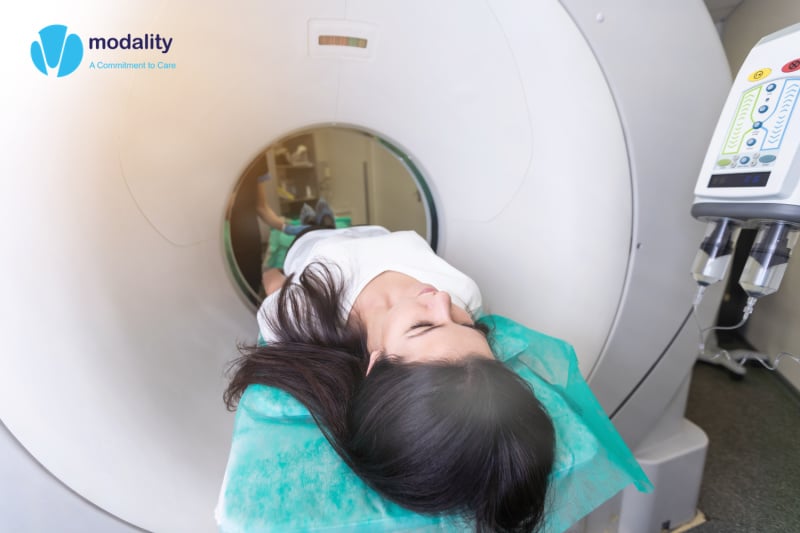
MRI (Magnetic Resonance Imaging) is an advanced imaging technique that uses radio waves and powerful magnets to produce detailed pictures of the inside of your body. Unlike X-rays or CT scans, it does not use radiation. For knee problems, MRI is particularly helpful because it gives clear images of the soft tissues in and around the joint.
An MRI of the knee near Sandwell is often requested to investigate ongoing pain, swelling, stiffness, locking, or a feeling that the knee is giving way. It can show structures such as the menisci (the “shock absorbers” of the knee), ligaments (including the ACL, PCL, MCL and LCL), cartilage, tendons, muscles, and surrounding soft tissues in very high detail. This helps identify issues that other scans might miss, such as ligament tears, meniscal injuries, cartilage damage, bone bruising, early arthritis, infection or inflammation.
By pinpointing the exact cause of your symptoms, a knee MRI can guide the most appropriate treatment plan – whether that is rest, physiotherapy, medication, injections, bracing or surgery.
Book a Private MRI Scan with Our Partner
We work closely with Modality to refer patients when needed for a private MRI scan. If you think you may need an ultrasound or an MRI, please call our clinic, and we will advise accordingly.
You may have a closed or open scanner for your MRI depending on individual circumstances. This will be discussed during your consultation.

Why Choose Our Private Ultrasound Scan Clinic?
1. Expert Sonographers: Our clinic boasts highly skilled and experienced sonographers specialising in Diagnostics and Pregnancy scans.
2. State-of-the-Art Technology: We use cutting-edge ultrasound systems for precise and reliable imaging.
3. Comfortable and Discreet Setting: Our clinic ensures a comfortable and confidential patient environment.
4. Flexible Appointments: We offer flexible dates and times to suit your convenience.
5. Prompt Results: Immediate findings are discussed during your appointment, and a detailed report and images are emailed to you the same day.
Meet the Team
Lydia, our CQC Registered Manager and Operations Director, leads the team with empathy, faith and the utmost integrity. Her patient-focused approach helps to shape the culture of our service.
Our Consultant Radiologist Dr Moti, is supported by our advanced sonographer Andrew, combine clinical excellence with reassurance, giving our patients peace of mind and genuine warmth. Ali brings clarity to every scan and calm assurance, helping patients feel at ease, supported, and well-informed.
Behind the scenes, Emma, our practice manager, plays a pivotal role, ensuring every detail of the patients’ journey is seamless. She works alongside the Registered Manager to ensure quality assurance is maintained.
Carly, our Medical Administrative Officer, plays a crucial role in patient experience and works alongside the Registered Manager to maintain high-quality standards through promoting continuous improvement across the practice.
Together as a team, we are united by one purpose:
Our Mission - To deliver high-quality care with compassion that not only meets the patients’ expectations but goes over and beyond to exceed expectations.
It's easy to book an appointment.
Universal Ultrasound Diagnostics offers an online booking system for easy appointment scheduling. There are options for walk-ins depending on availability: urgent scans within 5 days and routine scans within 14 days.
Appointment notifications and reminders are sent via email. The system supports self-check-in and online referrals by GPs.
We provide chaperones and interpreting services and allow family presence during pregnancy scans.
Our facility is accessible by public transport and has parking.
We allow family presence for most scans; however, children are not allowed in the room for certain scans. Please check your appointment confirmation email for clarity on our safety policy.
Our FAQ page answers a lot of general questions about your scan.
There is parking around The Green or Pay & Display at the side of The Bulls Head Pub, which charges £1 per hour (cash and card accepted). We are open 8 am to 11 pm Monday to Sunday.
Opening Times
Monday to Sunday 8 am - 11 pm
Location
10c The Green, Kings Norton, Birmingham, B38 8SD

Knee Soft Tissue Scan Faqs
Is Knee Ultrasound Painful?
No, knee ultrasound is non-invasive and painless. Your sonographer may move your knee into different positions during the scan, which may be uncomfoterbale.
Can an Ultrasound Detect a Knee Tear?
Ultrasound scans can identify some tears and injuries to the knee; however, the accuracy depends largely on the type and location of the damage.
For same day peace of mind, book your knee ultrasound scan near Sandwell
What can a knee ultrasound detect?
- Ligament and Tendon Tears – Effectively identifies injuries to the quadriceps tendons, patellar tendon, and collateral ligaments (MCL, LCL).
- Fluid Buildup (Joint Effusion) – Detects any swelling caused by inflammation or injury.
- Muscle Strains & Tears – Helps to visualise any soft tissue damage.
- Baker’s Cysts – Identifies any fluid-filled sacs behind the knee, and this may be linked to other knee conditions.
Limitations of Ultrasound for Knee Injuries:
While it is possible to detect meniscus tears or severe ligament damage with an ultrasound, this type of injury can require an MRI scan instead, as MRI can penetrate deeper into the joint. Specifically bone related conditions such as fractures or damage to the cartilage are best evaluated using an MRI scanner or an X-ray machine.
For same day peace of mind, book your knee ultrasound scan near Sandwell
Can a knee ultrasound scan detect degenerative conditions like arthritis?
It is possible to detect some of the signs of degeneration associated with arthritis on an ultrasound scan, however there are limitations compared to other imaging techniques.
What Ultrasound Can Reveal About Arthritis:
Joint Effusion (Fluid Buildup) – It is possible to detect the swelling and inflammation of the knee joint, often associated with arthritis.
Synovitis (Inflamed Joint Lining) – Ultrasound can also help to identify the thickening of the synovial membrane, which is a common symptom of rheumatoid and osteoarthritis.
Baker’s Cysts – Also visible using ultrasound are the fluid filled sacs often found behind the knee that are also associated with arthritis.
Cartilage Thinning (Limited Detection) – In some cases it is possible for ultrasound to show loss of cartilage, however, it is not the most reliable method for assessing cartilage damage.
Limitations of Ultrasound for Arthritis:
Early-Stage Arthritis – Mild cartilage wear and tear or early joint degeneration may not be picked up on an ultrasound scan.
Bone Changes & Joint Space Narrowing – These common symptoms of arthritis are more easily picked up on an MRI or an X-ray.
Deep Joint Structures – Ultrasound is less effective for evaluating deep cartilage damage and bone abnormalities.
While an ultrasound can help support a diagnosis of arthritis by detecting such symptoms as inflammation, fluid build up and cartilage and soft tissue changes, it may not be possible to diagnose with these images alone. An X-ray may also be required in order to help identify any bone changes or joint space narrowing that can confirm arthritis. The best for early detection in arthritis though is MRI, which will be able to search for cartilage damage, meniscus wear and give a detailed joint evaluation.
Do not let knee pain slow you down—get the answers you need today. Book your same-day scan near Sandwell and get rid of the anxiety of the uncertainty.
How Should I Prepare for the Test?
Wear comfortable clothing that allows easy access to the knee. Follow any specific instructions provided our team.
Is Knee Ultrasound Safe?
Yes, it is safe and widely used for musculoskeletal assessment.
What are the red and blue blobs on the ultrasound?
During the scan the sonographer may use a colour doppler to check blood flow in your tissue and organs. This will appear as blue and red blobs on the image and are nothing to be concerned about.